

A large dog crate has to fit the dog before anything else. Measure standing height and nose-to-tail-base length, then choose between a folding wire crate for ordinary training and a heavier steel enclosure for dogs that need more robust hardware.
Quick picks
We screened 18 current Amazon candidates and ranked six 48-inch crates from five brands using published specifications. BestStuffGuide did not conduct escape, load, or durability testing.
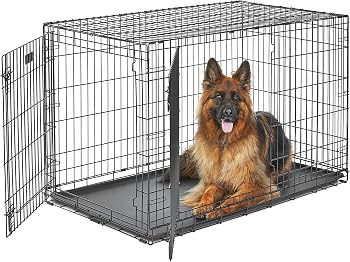
MidWest LifeStages 48-Inch Double-Door Dog Crate

LifeStages offers the clearest all-around package for a measured large dog: exact 48.5-by-30.25-by-32-inch dimensions, 90-110-pound starting guidance, heavier-gauge wire than a standard crate, two doors, a puppy divider, a leak-resistant tray, and tool-free folding setup. It is the most versatile finalist for ordinary home training without the bulk of a wheeled steel enclosure.
- 48.5 x 30.25 x 32 inches with published 90-110 lb guidance
- Heavier-gauge folding wire with front and side access
- Divider panel, pull-out tray, rubber feet, and carry handle

Exact dimensions, a published 90-110-pound starting range, low-threshold access, and an included divider give owners unusually clear fit and growth guidance.
MidWest documents heavier-gauge wire than its standard crate plus rounded clips and Paw Block slide-bolt latches for the intended everyday training role.
Tool-free folding assembly, two doors, a leak-resistant pull-out tray, rubber feet, and a carry handle simplify placement and routine cleaning.

Feandrea 48-Inch Heavy-Duty Double-Door Dog Crate
Feandrea pairs unusually specific 48-by-29.3-by-31.7-inch fit guidance with a heavier fixed frame, five L-shaped locks, a full entry door, and a smaller feeding door. The door and top panel can be removed for supervised open access, while a pull-out tray handles cleanup. It suits owners who want more structure than folding wire without losing practical everyday interaction.
- 48 x 29.3 x 31.7 inches with published 93-110 lb guidance
- Five L-shaped locks with a full door and a smaller feeding door
- Removable top and door plus a pull-out cleaning tray
The listing provides exact dimensions, a 93-110-pound starting range, a low threshold, and two access sizes for a measured large dog.
A heavy frame, smooth metal wire, and five L-shaped locks provide strong documented containment hardware without relying on literal escape-proof promises.
The small feeding door, removable top and main door, and pull-out tray reduce interaction and cleanup friction, though the heavier frame is less portable than folding wire.

MidWest iCrate 48-Inch Single-Door Dog Crate
The iCrate keeps the same clear 48.5-by-30.25-by-32-inch and 90-110-pound guidance as LifeStages at a lower observed price. A divider supports puppy-to-adult training, while the tray, rubber feet, handle, and tool-free fold make it easy to own. Its standard wire and single door are the compromises, so it fits routine crate training better than determined escape behavior.
- 48.5 x 30.25 x 32 inches with published 90-110 lb guidance
- Single-door folding wire design with Paw Block slide-bolt latches
- Divider panel, pull-out tray, rubber feet, and carry handle
Exact dimensions, published 90-110-pound guidance, a low threshold, and the divider make fit planning unusually transparent for a wire crate.
Rounded clips, protective coating, and Paw Block latches suit ordinary training, but the standard wire and single door are less reinforced than LifeStages or the steel finalists.
Tool-free folding, a leak-resistant tray, divider, rubber feet, and carry handle provide the easiest storage and movement in the final group.

LEMBERI 48-Inch Heavy-Duty Steel Dog Crate
LEMBERI documents 20-gauge steel panels, reinforced tubes, welded joints, two access points, dual locks, a floor grate, and an underlying slide-out tray. Most of the frame arrives assembled and four casters help with room-to-room placement. It is a higher-containment design, but owners still need to measure usable space and get behavioral help when confinement triggers panic.
- Published 20-gauge panels with reinforced steel tubes
- Front entry and top interaction door with dual locks
- Floor grate, slide-out tray, and four casters with two brakes
The listing identifies a 48-inch large-dog enclosure and two access points, but exact external dimensions and a measured dog range were not exposed in the checked evidence.
Published 20-gauge panels, reinforced tubes, welded joints, dual locks, and a supported floor grate make this the strongest documented frame in the finalist set.
Mostly pre-assembled setup, a slide-out tray, and braking casters are practical, while the 81.8-pound listed weight makes lifting and travel demanding.

BOLDBONE 48-Inch Heavy-Duty Steel Dog Crate
BOLDBONE offers a similar reinforced-steel layout at a comparatively moderate observed price: 20-gauge frame claims, 0.5-inch tubes, two slide-bolt latches, double-door access, removable cleaning parts, and braking swivel casters. It is easy to reposition on one floor, but the listing does not provide the same precise fit guidance as the MidWest and Feandrea picks.
- Published 20-gauge frame and 0.5-inch reinforced tubes
- Double doors secured by two slide-bolt latches
- Removable tray and pan with four braking swivel casters
The 48-inch listing targets large dogs and provides broad double-door access, but precise external dimensions and an intended measured range were not documented in the checked evidence.
Published 20-gauge frame construction, 0.5-inch tubes, and two slide-bolt latches provide strong hardware evidence without treating escape resistance as a guarantee.
Mostly pre-assembled setup, removable cleaning components, and braking swivel casters simplify care, though the fixed steel body does not fold for storage.

Oranland 48-Inch Reinforced-Base Dog Crate
Oranland centers its design on a reinforced baseplate, 20-gauge panels, thick tubes, and two removable cleaning trays. Most parts arrive assembled and the four wheels help with indoor repositioning. It ranks sixth because the checked listing provides limited measured fit guidance and repeats several unsupported comparative marketing claims that we do not use in the score.
- Reinforced baseplate with published 20-gauge panel construction
- Thick steel tube frame with a coated grid floor
- Removable plastic and metal trays plus four wheels
The exact listing identifies a 48-inch large-dog model, but it does not provide the clear dimensions, weight range, or divider guidance available from the higher-ranked picks.
The reinforced baseplate, published 20-gauge panels, thick-tube frame, and coated floor provide strong structural evidence, excluding unsupported comparative percentages.
Mostly pre-assembled construction, dual removable trays, and wheels aid cleaning and placement, but the fixed heavy frame and unclear exact dimensions limit portability planning.
Large dog crates compared
| Rank | Crate | Published external size | Published dog range | Crate and door design | Growth or access feature | Cleaning and mobility |
|---|---|---|---|---|---|---|
| 1 | MidWest LifeStages 48-inch | 48.5 x 30.25 x 32 in | 90-110 lb starting guidance | Heavier-wire folding crate; two doors | Divider panel; low thresholds | Pull-out tray; feet; carry handle |
| 2 | Feandrea 48-inch | 48 x 29.3 x 31.7 in | 93-110 lb starting guidance | Fixed heavy-duty frame; large and feeding doors | Removable top and main door | Pull-out tray; fixed placement |
| 3 | MidWest iCrate 48-inch | 48.5 x 30.25 x 32 in | 90-110 lb starting guidance | Standard folding wire; single door | Divider panel; low threshold | Pull-out tray; feet; carry handle |
| 4 | LEMBERI 48-inch | 48-inch class; exact dimensions not documented | Large dogs; measure individual dog | 20-gauge steel panels; front and top doors | Top interaction access; no divider documented | Floor grate; slide-out tray; braking casters |
| 5 | BOLDBONE 48-inch | 48-inch class; exact dimensions not documented | Large dogs; measure individual dog | Reinforced steel; double doors | Low-threshold access; no divider documented | Removable tray/pan; braking casters |
| 6 | Oranland 48-inch | 48-inch class; exact dimensions not documented | Large dogs; measure individual dog | Reinforced steel with coated grid floor | No divider documented | Plastic and metal trays; four wheels |
Weight ranges are only a starting point. A crate must fit the individual dog’s measured body and normal resting posture.
How we ranked these crates
This is a desk-research comparison. BestStuffGuide did not test escape resistance, weld strength, floor load, coating durability, or long-term tray performance. We captured 30 first-page Amazon results, screened 18 distinct candidates, and kept six exact 48-inch listings from five brands. Every finalist had a current observed price above $50 and enough published information to compare fit, construction, access, and cleaning.
Fit and space make up 40% of the Editorial Rating. We looked for exact external dimensions, a published dog range, low-threshold access, and a divider. Structure and security account for 35%, including wire or steel construction, reinforcement, doors, latches, and stability. Setup and upkeep make up the remaining 25%, with attention to folding or pre-assembled setup, trays, floors, wheels, and handles.
The ranking follows the unrounded weighted score. We did not repeat literal “indestructible” claims or treat any crate as a guaranteed fix for escape behavior.
Measure the dog, not the breed label
Have the dog stand naturally. Measure from the tip of the nose to the base of the tail, then measure from the floor to the top of the head or ears, whichever is higher in a normal stance. Add the clearance recommended by the crate maker. The dog should be able to enter without ducking sharply, turn around, lie on its side, and rest without pressing against every wall.
Breed examples and weight bands help narrow the search, but two dogs of the same weight can have different height and body length. MidWest and Feandrea publish precise dimensions and starting weight guidance for the exact finalists. The steel listings provide less complete fit evidence, so measure the available interior space before ordering.
Wire crate or reinforced steel crate?
Folding wire for ordinary home training
A folding wire crate is easier to store and move. The MidWest LifeStages and iCrate models include dividers, which let an owner reduce the usable area for a growing puppy and expand it later. Their open wire walls also make it easy to see the dog and place a cover only when appropriate.
LifeStages uses heavier wire and adds a second door, so it is the stronger everyday option. iCrate is lighter in specification and has one door, but it keeps the same sizing guidance and divider. Neither should be treated as a containment solution for a dog that bends wire or panics when confined.
Steel frames for more demanding hardware needs
Feandrea, LEMBERI, BOLDBONE, and Oranland use fixed or mostly fixed frames. They add thicker tubes or panels, more latch hardware, top or feeding access, and casters. That extra structure makes sense only when the dog fits comfortably and can tolerate confinement without injuring itself.
Casters help with room-to-room movement, but they do not make an 80-pound crate convenient for travel. Lock every braking caster before the dog enters, and check that the frame cannot roll or rock on the floor.
Doors, dividers, and daily access
Door placement matters more than it first appears. A side door can make a crate fit a bedroom or living room where the front opening would face a wall. A small feeding door or top opening lets an owner place food or interact with the dog without opening the main entry. Those openings still need secure latches, and they should not become a substitute for normal exercise and contact.
A divider is useful when the same crate will serve a growing dog. Set it so the puppy can stand, turn, and lie down comfortably. Too much empty space can work against housetraining, while too little space is uncomfortable and unsafe. Recheck the divider position as the dog grows.
Floor and tray design
The MidWest and Feandrea crates use pull-out trays that sit under the dog. The steel models may pair a grate or reinforced floor with one or two collection trays. Confirm that the floor surface supports paws without wide gaps, sharp edges, or a loose panel that shifts under weight.
Slide the tray fully into its retaining position before use. A tray that sticks out can catch a paw or leak onto the floor. Wash it with products permitted by the manufacturer, rinse away residue, and let every surface dry before the dog returns. Inspect coated bars and welds while the tray is out.
Crate training and distress
Introduce the crate in short, positive sessions. Leave the door open at first, reward calm entry, and build duration gradually. Do not use the crate as punishment. A dog that drools heavily, screams, bites bars, throws its body at doors, or injures its mouth and paws is not simply asking for thicker steel.
Repeated panic or escape attempts call for a veterinarian or qualified behavior professional. A heavier crate may contain some dogs more securely, but it can also increase injury risk if distress continues. The right plan addresses the behavior and the enclosure together.
Safety checks before every use
Remove collars, tags, harnesses, and other neckwear before unsupervised crating because they can catch on wire or hardware. Run a hand along accessible edges and check for bent wire, cracked welds, loose bolts, exposed points, damaged coating, or a latch that no longer closes fully. Confirm that trays, dividers, and caster brakes are locked into position.
Place the crate on a level surface away from heat sources and direct weather. A listing that mentions outdoor use does not make the crate comfortable in heat, cold, rain, or sun. Provide normal water, bathroom, exercise, and supervision breaks based on the dog’s age, health, and training plan.
Frequently asked questions
Is a 48-inch crate big enough for every large dog?
No. A 48-inch label describes one exterior dimension, not the dog’s usable floor and head space. Measure standing height and body length, then compare those numbers with the exact crate dimensions. Very tall or long dogs may need a larger model even when their weight falls inside a published range.
Does a heavier crate stop separation anxiety?
No. Steel construction can provide stronger hardware, but it does not treat fear or panic. If a dog harms itself, repeatedly tries to escape, or becomes intensely distressed, stop relying on the crate alone and consult a veterinarian or qualified behavior professional.
Should I choose a wire floor or a solid tray?
A solid supported surface is usually simpler for resting paws. Some reinforced steel crates place a grate above a collection tray. Inspect the gap size, stability, and coating, and add only bedding that the dog can use safely. Remove any mat the dog tears and swallows.
Can I leave a collar on in the crate?
Remove collars, tags, harnesses, and other neckwear before unsupervised crating. Hardware can catch on wire, doors, dividers, or latches.
How often should I inspect the crate?
Give latches, doors, trays, floor panels, dividers, wheels, bolts, wire ends, and welds a quick check before use. Do a closer cleaning inspection whenever you remove the tray. Stop using the crate if a damaged part creates a sharp edge, loose opening, or unstable floor.
Final verdict
MidWest LifeStages is the best overall choice for ordinary home training because it combines precise 48-inch sizing guidance, heavier wire, two doors, a divider, and simple folding upkeep. Feandrea is the better fit when you want a fixed heavier frame with precise dimensions and multiple access points. MidWest iCrate is the value pick for a dog suited to standard wire. LEMBERI, BOLDBONE, and Oranland provide more reinforced hardware, but their fit documentation is less complete and their weight makes placement more demanding.