

Kerosene heaters split into two very different groups: cordless wick models for limited emergency room heat and powered forced-air or radiant machines for ventilated work areas. Our six picks cover both, but the heater type and approved location matter more than raw BTU. Check the model manual and local rules before buying.
Quick picks
The Comfort Glow KW-24J leads for broad off-grid room heat, while Sengoku’s HMN-110 is the better fit for a smaller space. The four powered picks target garages, workshops, and jobsites.

Comfort Glow KW-24J Kerosene Convection Heater

The KW-24J is the clearest all-around choice for shoppers who specifically need non-electric emergency heat: its 23,800 BTU convection design distributes heat in all directions, the current listing documents up to 1,000 square feet and 12 hours, and the long-running WK95/KW24 platform has stronger support than the flood of generic wick heaters. It still requires the manual's ventilation, clearance, fuel, and supervision rules.
- 23,800 BTU 360-degree convection format
- Published coverage up to 1,000 sq ft
- Up to 12 hours on one tankful

The 23,800 BTU convection format and 360-degree heat pattern suit broad emergency room heating better than directional wick models.
Up to 12 hours of cordless operation covers an overnight-length emergency session, although the heater must not be used while occupants sleep.
The established platform has simple ignition and shutoff controls, but it lacks the thermostat and diagnostics found on powered work-area units.

Sengoku HeatMate HMN-110 Kerosene Heater
The HMN-110 trades maximum coverage for a more manageable 10,000 BTU output, a 1.2-gallon tank, and up to 14 hours of published runtime. Push-button ignition, tip-over protection, and automatic shutoff make its control package unusually complete among compact wick heaters, while Sengoku's model-specific manuals give buyers a better ownership trail than generic imports.
- 10,000 BTU for spaces up to 400 sq ft
- 1.2-gallon tank with up to 14-hour runtime
- Push-button start, tip switch, and automatic shutoff
The lower 10,000 BTU output is a better match for smaller spaces but cannot cover the broader area of full-size convection heaters.
Up to 14 hours from a 1.2-gallon tank is an excellent off-grid duration for this output class.
Push-button ignition, tip-over protection, automatic shutoff, and accessible model documentation provide the strongest compact-heater control package here.

Reddy Heater RFA50-V3 Forced-Air Kerosene Heater
The RFA50-V3 is the sensible powered choice when a garage or small jobsite needs directed heat without stepping up to an 80,000 BTU machine. Its five-gallon tank and published 14-hour runtime reduce refueling interruptions, while the current listing identifies the exact contractor-grade configuration and CSA wording. It requires electricity and the ventilation specified for forced-air combustion heaters.
- 50,000 BTU forced-air output
- Published coverage up to 1,250 sq ft
- Five-gallon tank with up to 14-hour runtime
The 50,000 BTU forced-air format is well matched to ventilated garages and smaller jobsites rather than occupied living areas.
A five-gallon tank and 14-hour published runtime provide the longest work-session planning window among the powered finalists.
The contractor platform and certification wording are reassuring, though the listing documents fewer automation features than the RFA80T-V3.
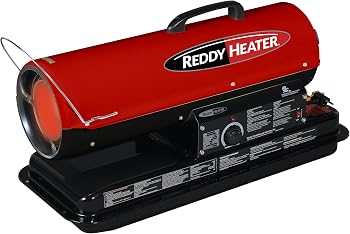
Reddy Heater RFA80T-V3 Forced-Air Kerosene Heater
Choose the RFA80T-V3 when thermostat control and faster large-area recovery matter more than all-day runtime. The 80,000 BTU forced-air design is listed for up to 2,000 square feet, and the current configuration adds a thermostat and LED diagnostics to a five-gallon platform. Its powered, high-output design belongs in ventilated construction, workshop, or garage settings—not ordinary living or sleeping rooms.
- 80,000 BTU forced-air output
- Thermostat and LED diagnostics
- Five-gallon tank with up to 8.5-hour runtime
The 80,000 BTU output and 2,000-square-foot claim make it the strongest conventional forced-air fit for larger ventilated work areas.
The five-gallon tank is practical, but 8.5 hours is shorter than the lower-output RFA50-V3's published runtime.
A thermostat and LED diagnostics add useful control and troubleshooting information beyond basic forced-air models.

SUNFIRE SF80 Radiant Kerosene Heater
The SF80 is the specialist pick for buyers who want quieter radiant heat instead of a conventional torpedo-heater blast. Its 80,000 BTU platform, six-gallon tank, roughly 10-hour published runtime, and automatic-shutdown positioning are well documented. The large price premium and work-area ventilation requirements keep it from ranking higher, and BTG does not treat broad no-fume marketing language as permission for unrestricted indoor use.
- 80,000 BTU radiant heat format
- Six-gallon tank with about 10-hour runtime
- Portable chassis with automatic-shutdown positioning
Radiant delivery is a compelling quieter alternative for targeted work-area heat, though its premium design serves a narrower audience.
The six-gallon tank and 10-hour runtime support a full shift, but size, cost, and power needs reduce general portability.
Automatic-shutdown positioning and strong maker documentation help, but operating location and ventilation still require strict manual compliance.

VEVOR 70,000 BTU Forced-Air Kerosene Heater
VEVOR's 70,000 BTU model is the value play for a ventilated workshop or jobsite that still needs a thermostat and five-gallon tank. It undercuts the established forced-air finalists while keeping the basic capacity and control features buyers expect. The lower rank reflects thinner model-specific documentation and current owner evidence, so buyers should verify the included manual, service path, fuel compatibility, and exact shutdown features before relying on it.
- 70,000 BTU forced-air output
- Built-in thermostat
- Five-gallon fuel tank
The 70,000 BTU forced-air design fits ventilated workshops and jobsites, but comparable coverage documentation is limited.
The five-gallon tank supports practical sessions, while the checked evidence did not settle a comparable runtime figure.
A thermostat covers basic control, but shutdown, diagnostic, and service documentation is thinner than the Reddy Heater finalists.
How the six kerosene heaters compare
| Rank | Heater | Type | Published output | Published coverage | Tank and runtime |
|---|---|---|---|---|---|
| 1 | Comfort Glow KW-24J | Wick convection; non-electric | 23,800 BTU | Up to 1,000 sq ft | Platform: 1.9 gal; 8 to 12 h |
| 2 | Sengoku HeatMate HMN-110 | Wick radiant/convection; non-electric | 10,000 BTU | Up to 400 sq ft | 1.2 gal; up to 14 h |
| 3 | Reddy Heater RFA50-V3 | Forced air; powered | 50,000 BTU | Up to 1,250 sq ft | 5 gal; up to 14 h |
| 4 | Reddy Heater RFA80T-V3 | Forced air; powered | 80,000 BTU | Up to 2,000 sq ft | 5 gal; up to 8.5 h |
| 5 | SUNFIRE SF80 | Radiant; powered | 80,000 BTU | Not confirmed | 6 gal; about 10 h |
| 6 | VEVOR 70,000 BTU | Forced air; powered | 70,000 BTU | Not confirmed | 5 gal; runtime not confirmed |
Coverage and runtime are published claims, not results from a common test. Building insulation, outdoor temperature, air movement, fuel grade, wick condition, and heater setting can change what you get in practice.
Choose the heater type first
Wick convection and radiant heaters
A wick heater burns without household electricity, which is why the Comfort Glow and Sengoku models make sense for emergency heat. The tradeoff is manual operation. You must use the specified kerosene, set and maintain the wick correctly, provide the ventilation required by the manual, and stay with the heater while it runs.
The Comfort Glow’s larger convection format spreads heat around the heater and suits a broader area. The Sengoku has less output but a smaller footprint, longer published runtime, and a more explicit set of shutdown features.
Forced-air heaters
Forced-air heaters burn fuel in a chamber and use an electric fan to push hot air in one direction. They warm a ventilated garage or jobsite quickly, but they are noisy, need electrical power, and are not substitutes for a residential furnace. The RFA50-V3 favors runtime. The RFA80T-V3 adds more output, a thermostat, and LED diagnostics. VEVOR costs less but has thinner model-specific documentation.
Radiant work-area heaters
The SUNFIRE SF80 directs radiant heat toward people and surfaces instead of relying on a high-velocity air stream. That is useful when a conventional torpedo heater’s noise and airflow are unwelcome. The price is much higher, and the same combustion, clearance, ventilation, fuel, and supervision rules still apply.
Kerosene heater safety
Kerosene combustion can produce carbon monoxide and other pollutants. Read the exact model manual before the first use, and follow its rules for approved locations, ventilation, clearances, fuel, electrical supply, lighting, shutdown, and storage. A product-page claim such as “indoor” does not cancel those instructions or local fire and building rules.
- Use only the fuel grade listed by the manufacturer. Gasoline or a mixed fuel can cause a fire or explosion.
- Keep the heater level and away from curtains, bedding, paper, fuel containers, traffic paths, children, and pets.
- Use the ventilation the manual requires. Keep a working carbon-monoxide alarm where applicable, but do not treat an alarm as a substitute for ventilation.
- Turn the heater off before leaving the area. Never run an unvented heater while sleeping.
- Let the heater cool, then refuel it outdoors. Clean spills before relighting.
- Do not use a powered forced-air or radiant model in a living or sleeping room unless the exact manual specifically permits that setting and every listed condition is met.
How we chose
We screened 48 organic Amazon results and kept 20 complete heaters priced at $50 or more for closer review. The final six cover five brands and three heater formats. We excluded fuel, replacement parts, electric and propane heaters, duplicate generic stoves, unavailable models, and listings with unclear product identity.
Heating fit counts for 40 percent of the Editorial Rating. Runtime readiness and Controls and safeguards each count for 30 percent. The scores use current published specifications and operating documentation. Best Stuff Guide did not test heat output, runtime, noise, emissions, fuel use, or durability.
What to check before buying
Approved location
Start with the model manual, not the product-page headline. A cordless wick heater and an 80,000 BTU forced-air unit solve different problems. If the manual does not allow your room, garage, workshop, tent, or jobsite, choose another heat source.
Output and heat pattern
BTU tells you the maximum published heat rate, but the delivery pattern matters. Convection models spread heat around the unit. Forced-air models throw heat in one direction. Radiant models warm people and surfaces in their line of sight. Published square-foot claims are rough planning figures, not guarantees.
Runtime, tank, and electricity
Compare runtime at the stated output, then check tank size and refueling access. A forced-air or powered radiant heater still stops when the electricity fails. A wick model can run without household power, but ignition systems may use batteries.
Controls and service parts
A thermostat helps a jobsite heater cycle around a target temperature. Diagnostics can shorten troubleshooting. For a wick heater, confirm that the correct replacement wick, igniter parts, and model manual are still available. Product support matters more than an extra feature on a generic listing.
FAQs
Can a kerosene heater be used indoors?
Only when the exact model is approved for that setting and you follow every manual requirement for fuel, ventilation, clearance, supervision, and shutdown. Many forced-air and high-output radiant heaters are intended for ventilated work areas. Never use an unvented heater while sleeping.
Is a higher BTU rating always better?
No. Output must match the heater type and the space. Too much direct heat can create clearance and comfort problems, while a small heater may run continuously without warming the area. Start with the approved location and heat pattern, then size the output.
Can diesel be used in a kerosene heater?
Some forced-air models list multiple approved fuels, but wick heaters commonly require a specific kerosene grade. Use only the fuels named in the exact model manual. Do not assume that a fuel accepted by one heater is safe in another.
How often does a kerosene heater need a new wick?
There is no universal replacement interval. Fuel quality, storage, carbon buildup, wick adjustment, and operating hours all affect service life. Follow the model manual’s cleaning, dry-burning, inspection, and replacement procedure.
Final verdict
The Comfort Glow KW-24J is our first choice for broad, non-electric emergency room heat where its manual and local rules permit use. Pick the Sengoku HMN-110 for a smaller area and a longer published runtime. For a ventilated garage or jobsite, the Reddy Heater RFA50-V3 favors runtime, while the RFA80T-V3 offers more output, thermostat control, and diagnostics.