

A camera gimbal has to balance your complete body and lens before its tracking modes matter. We compared seven current three-axis gimbals by published payload, balancing workflow, carry weight, runtime, vertical shooting, camera control, and tracking hardware.
Quick picks
We screened 16 organic Amazon US listings and ranked seven available ASINs from four brands. Check the maker’s current compatibility list for your exact camera, lens, plate, cable, and accessories.

DJI RS 4 Mini Combo Camera Gimbal

The RS 4 Mini Combo combines a travel-friendly 2 kg rig class with automated axis locks, smoother Teflon-coated balancing surfaces, native vertical shooting, and the bundled tracking module and briefcase handle. It is the most complete compact package here, although heavier lenses can exceed its practical balance envelope before they exceed the headline payload.
- 0.4-2.0 kg published payload range
- Automated axis locks and Teflon-enhanced balancing
- Combo includes tracking module and briefcase handle

The 2 kg ceiling covers many mirrorless bodies and moderate lenses, but it offers less headroom than the 2.5-3.5 kg finalists.
Automated locks, Teflon-enhanced adjustment, a compact body, and the briefcase handle make repeated setup unusually approachable.
Native vertical shooting, bundled intelligent tracking, Bluetooth control, and a 13-hour stationary runtime cover solo and mobile production well.

DJI RS 4 Camera Gimbal
DJI's standard RS 4 is the safer choice for full-frame bodies, standard zooms, and accessory-heavy setups because its published payload rises to 3 kg. Teflon axis arms, native vertical mounting, extensive control ports, and RSA/NATO expansion make it the strongest conventional production platform, but it is larger and its tracking hardware is not included in this standard listing.
- 3 kg (6.6 lb) published payload
- Teflon axis arms and native vertical shooting
- RSA/NATO expansion plus camera and focus control ports
A 3 kg payload and extensive camera-system connections give it strong headroom for mainstream professional mirrorless rigs.
Teflon-coated arms, axis locks, and DJI's mature control layout support repeatable balancing, with size as the main tradeoff.
Native vertical mounting, control and motor ports, RSA/NATO expansion, and 12-hour stationary runtime are broad, but tracking requires additional hardware.

FeiyuTech SCORP-C2 AI Camera Gimbal
SCORP-C2 publishes the highest payload in this group at 3.5 kg while keeping built-in AI tracking, gesture control, vertical shooting, and a 14-hour battery claim near the price of many compact models. It is compelling for creators who want headroom without DJI pricing, though its quick-release ecosystem and exact camera-control compatibility deserve a closer pre-purchase check.
- 3.5 kg (7.72 lb) published payload
- Built-in AI tracking and gesture control
- Vertical shooting and up to 14-hour runtime
The 3.5 kg ceiling is the highest checked payload, giving substantial published headroom for larger bodies, lenses, and accessories.
The integrated underslung form and current controls are useful, but the checked evidence is less detailed about repeatable plate and axis adjustment than DJI's.
Built-in tracking, gestures, vertical mode, and a 14-hour battery claim make the feature set unusually broad for the price.
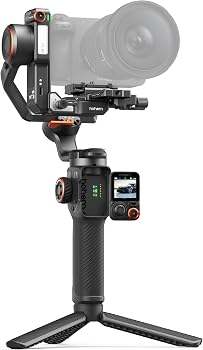
Hohem iSteady MT3 Pro Camera Gimbal
The iSteady MT3 Pro is built around solo operation: its reversible tracker adds CCT/RGB light, while the detachable touchscreen controller can provide remote framing and setting control. A 2.5 kg payload, Arca-Swiss release, vertical options, expansion ports, and 20-hour battery claim make it versatile. The exact listing conflicts on product weight, stating both 1.5 lb and 1.07 kg, so buyers should verify the current specification rather than rely on either figure.
- 2.5 kg (5.5 lb) published payload
- Detachable touchscreen controller with AI tracker and light
- Arca-Swiss release, expansion ports, and up to 20 hours
A 2.5 kg payload covers many full-frame mirrorless kits while remaining below the heavier-duty 3-3.5 kg leaders.
Arca-Swiss mounting and a detachable controller improve workflow, but the exact listing conflicts on product weight and reduces carry-confidence.
Independent tracking, live remote control, adjustable light, vertical mounting, expansion ports, reverse charging, and long runtime lead the solo-shooting feature set.

ZHIYUN CINEPEER WEEBILL 3E Camera Gimbal
WEEBILL 3E reaches a published 3 kg payload at a comparatively accessible price and keeps native vertical shooting, Bluetooth shutter control, and a compact A4-size body. It is a strong value for standard mirrorless kits, but tracking and advanced remote control are not part of this base configuration and runtime claims vary across regional materials.
- 3 kg (6.6 lb) published payload
- Compact body with native vertical shooting
- Bluetooth shutter control and up to 16-hour runtime
A 3 kg payload provides strong headroom at this price, though the checked compatibility detail is not as extensive as DJI's.
The compact body and vertical conversion are attractive, but the source set provides less detail on locks and fine adjustment surfaces.
Native vertical shooting, Bluetooth control, and long runtime cover core needs, while tracking and richer remote features require other configurations.
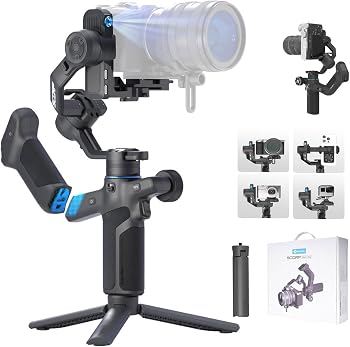
FeiyuTech SCORP Mini 3 Pro Camera Gimbal
SCORP Mini 3 Pro targets compact hybrid kits with a 2 kg payload, built-in long-range tracking, a detachable remote handle, native vertical shooting, and a 14-hour battery claim. Its all-in-one versatility is appealing, but buyers with long or front-heavy lenses should prefer the C2 or a 3 kg-class gimbal for more balance margin.
- 2 kg (4.4 lb) published payload
- Built-in tracking with published 18 m range
- Detachable remote handle and native vertical shooting
The 2 kg class suits compact mirrorless and mixed-device kits but leaves less room for long lenses and accessories.
An integrated underslung body, touchscreen, and detachable remote handle support flexible operation, with fewer verified fine-adjustment details.
Built-in tracking, remote handle, vertical shooting, broad device support, and a 14-hour battery claim form a strong compact feature package.

DJI RS 3 Mini Camera Gimbal
RS 3 Mini remains the lightest verified finalist at 795 g in vertical mode and handles up to 2 kg, with native vertical mounting and Bluetooth shutter control. It is an easy entry point for travel and compact mirrorless kits, but lacks the RS 4 Mini's automated locks, tracking interface, faster charging, and longer runtime.
- 0.4-2.0 kg published payload range
- 795 g vertical-mode gimbal weight
- Native vertical shooting and Bluetooth control
The 2 kg range is well documented and suitable for compact mirrorless rigs, but offers limited future accessory headroom.
Very low carry weight helps, but manual locks and an older adjustment workflow trail the RS 4 generation.
Native vertical shooting, Bluetooth control, and 10-hour stationary runtime cover essentials without current integrated tracking support.
Camera gimbals compared
| Rank | Gimbal | Published payload | Published gimbal weight | Published max runtime | Vertical and tracking |
|---|---|---|---|---|---|
| 1 | DJI RS 4 Mini Combo | 0.4-2.0 kg (0.9-4.4 lb) | About 890 g incl. plate | Up to 13 h stationary | Native vertical; tracking module included |
| 2 | DJI RS 4 | 3 kg (6.6 lb) | Gimbal 1066 g; grip 203 g | Up to 12 h stationary | Native vertical; tracking optional |
| 3 | FeiyuTech SCORP-C2 | 3.5 kg (7.72 lb) | — | Up to 14 h | Vertical; built-in AI tracking |
| 4 | Hohem iSteady MT3 Pro | 2.5 kg (5.5 lb) | — (listing conflict) | Up to 20 h | Vertical; tracker and remote included |
| 5 | ZHIYUN WEEBILL 3E | 3 kg (6.6 lb) | 1050 g | Up to 16 h | Native vertical; no tracking in base listing |
| 6 | FeiyuTech SCORP Mini 3 Pro | 2 kg (4.4 lb) | — | Up to 14 h | Native vertical; built-in AI tracking |
| 7 | DJI RS 3 Mini | 0.4-2.0 kg (0.9-4.4 lb) | 795 g vertical; 850 g horizontal | Up to 10 h stationary | Native vertical; no integrated tracking |
These are manufacturer or current-listing claims for the exact ASINs checked on August 28, 2026. Runtime test conditions differ. The Hohem listing gives two conflicting weight values, so the table leaves that comparison unresolved.
How we ranked the gimbals
This is a desk-research comparison. BestStuffGuide did not mount cameras, balance lenses, record walking footage, time batteries, measure motor torque, or test tracking. We screened 16 current organic Amazon US results and kept seven complete three-axis gimbals from four brands.
Rig capacity accounts for 40% of the Editorial Rating. We used published payload ranges, camera compatibility, clearance notes, and mounting details. Setup and balance contribute 35%, based on axis locks, quick-release design, adjustment surfaces, controls, carry weight, and handling layout. Shooting flexibility makes up 25%, using published runtime, vertical mounting, tracking, remote control, camera control, and accessory support.
Match the whole camera rig
Payload is only the starting point. Add the camera, lens, filter, quick-release plate, cage, microphone, receiver, monitor, cable, focus motor, and any counterweight before comparing that total with the gimbal’s range. A front-heavy zoom can be difficult to balance even when the scale says the rig is under the limit. Long lenses can also hit an arm before the motors run out of force.
Use the manufacturer’s current compatibility tool for the exact camera and lens. Check whether shutter control works over Bluetooth or needs a cable. If autofocus, focus motor, zoom control, or video transmission matters, confirm the relevant port and accessory combination rather than assuming support from the camera brand alone.
Two-kilogram models versus heavier gimbals
The DJI RS 4 Mini Combo, FeiyuTech SCORP Mini 3 Pro, and DJI RS 3 Mini top out at 2 kg. That class suits many compact and standard mirrorless kits, and lower carry weight matters during a long walk or repeated takes. The RS 4 Mini adds automated locks and the strongest compact setup workflow. The SCORP Mini 3 Pro trades some evidence depth for built-in tracking and a detachable remote handle. The older RS 3 Mini is lighter and less expensive but has fewer setup conveniences.
DJI RS 4 and ZHIYUN WEEBILL 3E move to a 3 kg class. FeiyuTech SCORP-C2 publishes 3.5 kg, the highest figure here. Extra capacity helps with full-frame bodies, larger zooms, cages, and focus accessories, but a larger number does not guarantee that every shape will clear or balance.
Balancing features that save time
Axis locks keep the arms from swinging while you mount the camera and make transport less awkward. DJI RS 4 Mini automates those locks, while both RS 4 models use low-friction Teflon-enhanced adjustment surfaces. A quick-release plate with clear position marks also helps you return to a previous balance after removing the camera.
Balance every axis with the gimbal powered off. The camera should stay near the position where you place it instead of falling to one side. After changing lenses, extending a zoom, moving a screen, or adding a cable, check the balance again. Motors can compensate for a small error, but persistent correction wastes battery and can add vibration or heat.
Vertical shooting and subject tracking
All seven finalists support a vertical orientation, but the conversion method and included hardware vary. Native vertical mounting is cleaner than adding a generic bracket because it preserves the maker’s intended plate and arm geometry. Rebalance after rotating the camera, even if the gimbal makes the switch quickly.
The RS 4 Mini Combo includes DJI’s tracking module. SCORP-C2 and SCORP Mini 3 Pro publish built-in tracking. Hohem pairs its tracker and adjustable light with a detachable touchscreen controller. Standard DJI RS 4 needs optional tracking hardware, while WEEBILL 3E and RS 3 Mini do not include integrated tracking in the checked base configurations.
Runtime numbers need context
DJI labels its 13-hour RS 4 Mini, 12-hour RS 4, and 10-hour RS 3 Mini figures as stationary tests with a balanced gimbal. Real use is shorter when the motors work harder, the camera draws power, tracking or a light is active, or the temperature is outside the test conditions. FeiyuTech, Hohem, and ZHIYUN also publish long maximum runtimes, but the conditions are not directly comparable.
For a long shoot, look beyond the largest hour count. Check charging time, whether the battery is integrated or removable, whether the gimbal can operate while charging, and whether reverse charging competes with the runtime you need.
Setup and transport checklist
- Confirm the exact camera and lens in the manufacturer’s current compatibility list.
- Weigh the full shooting configuration, including the plate, cage, microphone, monitor, cables, and motors.
- Check arm and roll-axis clearance at the focal length and screen position you plan to use.
- Balance all three axes with the gimbal powered off, then run the maker’s balance or motor calibration check.
- Secure axis locks or support the arms before transport.
- Rebalance after changing the lens, zoom position, filter, microphone, monitor, cable route, or camera orientation.
- Keep cables loose enough for movement but clear of the arms and motors.
- Use a safety strap when the shooting position creates a realistic drop risk.
Frequently asked questions
Is a 2 kg payload enough for a full-frame mirrorless camera?
It can be, but the complete body-and-lens combination must fit the maker’s compatibility list and clear the arms. A compact prime or standard zoom is easier than a long, front-heavy lens. Add every accessory to the total and check physical balance, not only weight.
Do I need built-in tracking?
Tracking is useful for solo presenters, walk-and-talk shots, and fixed-position filming where no operator can follow the subject. A camera operator may care more about payload, balance, controls, and accessory expansion. Check whether tracking works through a bundled module, an optional module, or the maker’s app.
Can I leave the same balance for every lens?
No. Lens length, weight distribution, zoom position, filters, and accessories change the center of gravity. Marking plate positions can speed up repeated setups, but each configuration still needs a balance check.
Why does a gimbal vibrate after setup?
Common causes include poor balance, motor strength set too high, a loose plate, a cable touching an arm, or a lens or screen contacting the frame. Turn the gimbal off, inspect the mounting points, rebalance, and run the manufacturer’s calibration procedure before filming.
Is maximum runtime a realistic shooting time?
Usually not. Maximum figures often come from a balanced gimbal sitting still. Movement, payload, tracking, lights, camera charging, temperature, and motor settings can shorten runtime.
Final verdict
DJI RS 4 Mini Combo is the best overall choice for a compact mirrorless setup because it combines automated locks, smooth balancing adjustments, native vertical shooting, and included tracking in a manageable 2 kg class. Choose DJI RS 4 when a heavier lens or accessory stack needs 3 kg of headroom. FeiyuTech SCORP-C2 offers the strongest payload value, while Hohem iSteady MT3 Pro has the richest remote-tracking setup. WEEBILL 3E is the budget 3 kg pick, SCORP Mini 3 Pro suits compact solo creators, and RS 3 Mini remains the lightest straightforward value option.