

Instant cameras split into two groups: analog models that expose film as soon as you press the shutter, and hybrids that let you preview a digital image before printing it. We compared seven current cameras by print system, controls, ease of use, portability, phone features, and exact bundle contents.
Quick picks
Fujifilm’s Instax Mini EVO is the best overall because it gives you the most control over which shots use film. Polaroid Now+ Generation 3 is the strongest creative analog option. KODAK’s Mini Shot 3 Retro is the best square hybrid bundle.

Fujifilm Instax Mini EVO Hybrid Instant Camera

The Mini EVO lets you preview a digital capture before spending film, store images internally or on microSD, combine 10 lens effects with 10 film effects, reprint favorites, and print phone photos. It preserves the Instax mini output while giving buyers the most control over which shots become physical prints.
- Preview and select images before printing on Instax mini film
- 10 lens effects times 10 film effects for 100 combinations
- Bluetooth phone printing, remote capture, internal memory, and microSD

Preview, storage, print history, reprints, and exposure compensation sharply reduce accidental film waste.
Ten lens effects and ten film effects create 100 in-camera combinations without relying entirely on a phone.
The checked listing is camera only, so Instax mini film and any microSD card add to the starting cost.

Polaroid Now+ Generation 3 Starter Bundle
Now+ keeps the full-size analog Polaroid result but adds app controls that simpler film cameras do not offer. Aperture priority, manual mode, remote controls, double exposure, self timer, and two-lens autofocus make it the shortlist's most flexible one-shot analog option.
- Full-size Polaroid i-Type or 600 film output
- App aperture priority, manual mode, remote, and creative controls
- Two-lens autofocus, USB-C charging, and 16 color exposures in bundle
The app opens aperture priority, manual exposure, remote triggering, and other modes while capture remains analog.
It uses full-size Polaroid film for a larger, classic border format than mini-film cameras.
Full-size Polaroid film and body make this a bag camera rather than a pocketable travel option.

KODAK Mini Shot 3 Retro 3×3 Camera and Printer
KODAK's 2-in-1 hybrid previews a 13MP capture so you can retake before printing, and it doubles as a Bluetooth phone printer. The checked bundle includes 38 3-by-3-inch 4PASS sheets, giving it the most complete consumables package in the shortlist.
- Preview and retake 13MP captures before 3 x 3-inch printing
- Bluetooth printing from iPhone and Android phones
- 4PASS dye-sublimation system with 38 sheets in the checked bundle
Thirty-eight sheets, cartridges, strap, USB-C cable, and camera make the checked variant unusually complete.
It prints its own captures and phone photos, with preview and retake control before paper is used.
4PASS dye-sublimation is a layered digital print process, not self-developing analog instant film.

Fujifilm Instax Mini 13 Point-and-Shoot Camera
Mini 13 is the most straightforward current analog pick: automatic exposure and flash, a selfie mirror, close-up framing correction, and both two- and ten-second timers. It uses widely recognized Instax mini film and includes the two AA batteries needed to start shooting, but film is separate.
- Automatic exposure and flash with simple point-and-shoot operation
- Close-up mode, selfie mirror, parallax correction, and two self-timer settings
- Instax mini film format powered by two replaceable AA batteries
Automatic exposure, automatic flash, a selfie mirror, and a simple lens-ring workflow minimize setup.
Close-up mode covers 0.3 to 0.5 meters and corrects viewfinder parallax for nearer subjects.
This is a deliberately analog camera with no phone printing, remote app, or image transfer.
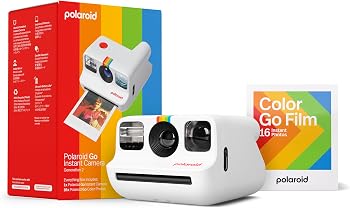
Polaroid Go Generation 2 Compact Starter Bundle
Polaroid Go is the smallest retained analog body and the checked bundle adds 16 Go-format photos. A selfie mirror, double exposure, self timer, USB-C charging, and battery guidance of up to 15 film packs give it a clear travel and party role, with smaller prints than full-size Polaroid.
- Compact body built around dedicated Polaroid Go film
- Selfie mirror, double exposure, self timer, and improved light sensor
- USB-C charging and 16 color photos in the checked bundle
The dedicated Go format produces the smallest body and print in the shortlist's analog group.
The checked variant includes 16 shots and charges by USB-C rather than relying on disposable batteries.
Go film is intentionally smaller than full-size Polaroid and Instax mini output, a tradeoff for portability.
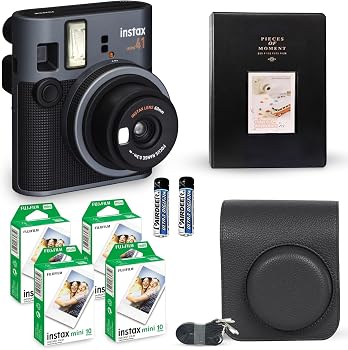
Fujifilm Instax Mini 41 40-Exposure Starter Bundle
Mini 41 pairs simple automatic exposure and flash with a selfie mirror and close-up mode, then adds 40 Instax mini exposures, a case, and an album in the checked bundle. It is a practical gift or party starter set when phone features and selective printing are not priorities.
- Automatic exposure, automatic flash, selfie mirror, and close-up mode
- Classic camera styling around the current Instax mini film system
- Checked bundle includes 40 exposures, a fitted case, and 64-pocket album
Forty exposures, a case, and an album make the exact bundle ready for an event or gift.
Automatic exposure and flash plus a selfie mirror keep the workflow approachable.
It offers close-up framing but no preview, exposure compensation, app modes, or selective printing.
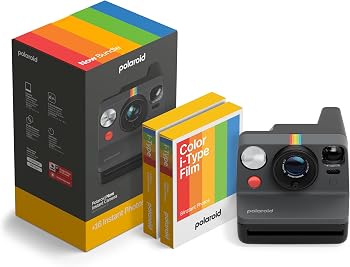
Polaroid Now Generation 3 Classic Starter Bundle
Now Generation 3 is the simpler route to full-size Polaroid prints. Its updated light-meter position, ranging sensor, and two-lens autofocus work automatically, while double exposure, self timer, tripod mount, filter compatibility, and USB-C charging preserve useful creative options without requiring an app.
- Full-size Polaroid i-Type or 600 film with two-lens autofocus
- Double exposure, self timer, tripod mount, and filter compatibility
- USB-C rechargeable camera with 16 color exposures in checked bundle
Automatic two-lens autofocus and full-size film deliver the most direct current Polaroid experience.
The camera handles exposure and lens selection automatically and keeps key creative modes on the body.
It omits the Now+ app's aperture-priority, manual-exposure, and remote-control features.
| Rank | Product | Print format | Capture type | Notable controls | Power | Checked bundle |
|---|---|---|---|---|---|---|
| 1 | Fujifilm Instax Mini EVO | Instax mini film; 62 x 46 mm image | Hybrid digital; 2560 x 1920 | AF, exposure compensation, 100 effect combinations | Built-in rechargeable battery; about 100 prints | Camera; film and microSD sold separately |
| 2 | Polaroid Now+ Generation 3 Starter Bundle | Polaroid i-Type or 600 full-size film | Analog; two-lens autofocus | App manual and aperture priority; double exposure; timer | USB-C rechargeable; listing says over 15 packs | Camera plus 16 color photos |
| 3 | KODAK Mini Shot 3 Retro | 3 x 3 in KODAK 4PASS cartridge paper | 13MP digital hybrid | Preview, retake, border or borderless app printing | Built-in rechargeable battery; USB-C cable included | Camera, four cartridges / 38 sheets, strap, cable, guide |
| 4 | Fujifilm Instax Mini 13 | Instax mini film; 62 x 46 mm image | Analog fixed-lens camera | Automatic exposure/flash; close-up; 2/10-sec timer | Two AA batteries; about 10 film packs | Camera, strap, accessory, two AA batteries; film separate |
| 5 | Polaroid Go Generation 2 Starter Bundle | Polaroid Go film | Compact analog fixed-focus camera | Double exposure; self timer; selfie mirror | USB-C rechargeable; up to 15 film packs | Camera plus 16 Go color photos |
| 6 | Fujifilm Instax Mini 41 Starter Bundle | Instax mini film; 62 x 46 mm image | Analog fixed-lens camera | Automatic exposure/flash; close-up; selfie mirror | Two AA batteries; about 10 film packs | Camera, 40 exposures, case, and 64-pocket album |
| 7 | Polaroid Now Generation 3 Starter Bundle | Polaroid i-Type or 600 full-size film | Analog; two-lens autofocus | Double exposure; timer; tripod and filter support | USB-C rechargeable; listing says over 15 packs | Camera plus 16 color photos |
These print systems are not interchangeable. Instax mini, Polaroid i-Type and 600, Polaroid Go film, and KODAK 4PASS cartridges differ in size, chemistry, handling, and ongoing cost. Bundle contents apply to the exact Amazon variants checked for this guide.
How we ranked instant cameras
This is a desk-research comparison, not a BTG camera or print test. Image control accounts for 20 percent of the score, print system for 18 percent, ease of use for 16 percent, portability and phone features for 12 percent each, bundle value for 8 percent, and evidence quality for 14 percent. Amazon listings control the exact ASIN, variant, availability, image, and included consumables. Official product pages support the camera and print-system specifications.
The Mini EVO ranks first because preview, storage, reprints, exposure compensation, and phone printing reduce wasted film while keeping the Instax mini format. Now+ takes second place by adding app-based manual and aperture-priority controls to an analog Polaroid camera. The KODAK Mini Shot 3 Retro follows with preview, retakes, phone printing, and 38 included 3-by-3-inch sheets.
Choose analog or hybrid before choosing a brand
An analog instant camera commits the shot when you press the shutter. There is no preview or delete button, and each exposure uses one sheet of film. That constraint is part of the appeal for many buyers. Polaroid Now+, Polaroid Now, Polaroid Go, Instax Mini 13, and Instax Mini 41 all follow this one-shot workflow.
Hybrid cameras capture a digital image first. The Mini EVO lets you inspect a shot before printing it, store images internally or on microSD, and reprint favorites. KODAK’s Mini Shot 3 Retro also lets you preview and retake, then prints through its 4PASS cartridge system. Both can print phone photos, which makes them more flexible at parties or when several people want to share images.
The tradeoff is feel. A hybrid can save consumables and offer more control, but it behaves partly like a digital camera and printer. Buyers who want the uncertainty and developing process of instant film may prefer a simpler analog model.
Film and paper formats change the experience
Instax mini film produces a 62 x 46 mm image inside its familiar small frame. The Mini EVO, Mini 13, and Mini 41 use this format, so their film is easier to share across those cameras. The Mini 13 and Mini 41 expose film directly. The Mini EVO prints a selected digital image onto the same format.
Polaroid Now+ and Polaroid Now use full-size i-Type or 600 film. Their larger bodies and prints are less convenient to carry than the compact options, but they provide the classic full-size Polaroid look. Polaroid Go uses its own smaller Go film. The camera is easier to pack, though its film does not fit the larger Polaroid models.
KODAK 4PASS is a layered dye-sublimation process rather than self-developing film. The Mini Shot 3 Retro prints 3-by-3-inch photos from its own digital camera or a connected phone. Its cartridges and paper are specific to the system.
Controls range from automatic to app-driven
Instax Mini 13 is the simplest point-and-shoot choice here. It handles exposure and flash automatically and adds a selfie mirror, close-up framing correction, and two self-timer settings. Mini 41 follows a similarly automatic approach, with close-up mode and a selfie mirror but no preview or phone connection.
Polaroid Now Generation 3 also handles exposure and lens selection automatically. It adds double exposure, a self timer, tripod support, and filter compatibility without asking you to use an app. Now+ Generation 3 is the more demanding and more flexible version. Its app opens manual exposure, aperture priority, remote controls, and other creative modes while the capture remains analog.
The Mini EVO’s controls sit between those two approaches. It uses autofocus and exposure compensation, combines ten lens effects with ten film effects, and gives you a preview before printing. That makes it easier to experiment without using a sheet of film for every attempt.
Portability and power
Polaroid Go is the compact analog pick. Its dedicated film keeps the body and prints smaller than full-size Polaroid, and the checked starter bundle includes 16 photos. It charges through USB-C and has published guidance of up to 15 film packs per charge.
The Mini EVO, Now+, Now, and Mini Shot 3 Retro use built-in rechargeable batteries. Mini 13 and Mini 41 run on two replaceable AA batteries, with official guidance of about ten 10-exposure film packs. AA power can be convenient on a trip, but spare batteries and film still need space in the bag.
Which instant camera fits which buyer
For selective printing and phone photos
Choose the Instax Mini EVO if you want Instax mini prints without committing every shutter press to film. It is the most complete mix of preview, storage, effects, reprints, and phone printing in this group. The checked listing does not include film or a microSD card.
For creative analog control
Polaroid Now+ Generation 3 is the analog choice for buyers who will use app controls. Its manual and aperture-priority modes, remote features, double exposure, self timer, and two-lens autofocus go well beyond the simpler instant cameras. The checked bundle includes 16 full-size photos.
For a complete square-print bundle
KODAK Mini Shot 3 Retro makes sense when preview, retakes, phone printing, and included consumables matter more than analog film. The checked package includes 38 sheets and the cartridges needed for its 3-by-3-inch 4PASS output.
For simple Instax shooting
Instax Mini 13 is the better fit for a beginner who wants a current camera without a phone workflow. Mini 41 is the stronger starter bundle because the checked variant adds 40 exposures, a case, and an album. Both use Instax mini film and automatic exposure.
For compact or full-size Polaroid
Polaroid Go Generation 2 favors portability and smaller prints. Polaroid Now Generation 3 is the simpler route to full-size Polaroid output without the Now+ app controls. Both checked bundles include 16 photos.
Before you buy
- Pick the print format first. Film and cartridges do not work across the Instax mini, full-size Polaroid, Polaroid Go, and KODAK 4PASS systems.
- Decide whether you want an analog one-shot process or a hybrid preview-and-print workflow.
- Check the exact bundle. Camera-only listings and starter kits can use the same product name while including different amounts of film, paper, cases, or accessories.
- Look at the ongoing consumable cost, not only the camera price.
- Choose built-in rechargeable or replaceable AA power based on how and where you plan to use the camera.
- If phone printing matters, confirm that feature before buying. Most analog models in this guide do not print from a phone.
Final verdict
Fujifilm’s Instax Mini EVO is the best overall instant camera in this shortlist because it combines Instax mini output with preview, storage, reprints, effects, and phone printing. Polaroid Now+ Generation 3 is the best creative analog camera, while KODAK’s Mini Shot 3 Retro is the strongest square hybrid bundle. Instax Mini 13 is the easiest starting point, Polaroid Go is the most portable analog choice, Mini 41 has the most useful Instax starter package, and Polaroid Now Generation 3 keeps full-size Polaroid shooting simple.
Frequently asked questions
Can instant cameras save digital photos?
Some can. The Instax Mini EVO stores digital captures internally or on microSD and lets you select which ones to print. The KODAK Mini Shot 3 Retro is also a digital hybrid. The analog models in this guide expose film directly and do not save a digital copy.
Can an instant camera print photos from a phone?
The Instax Mini EVO and KODAK Mini Shot 3 Retro can print phone photos. The Polaroid Now+ app adds camera controls, but the camera still exposes analog film and does not work as a phone-photo printer.
Is Instax mini film compatible with Polaroid cameras?
No. Instax mini, Polaroid i-Type and 600, and Polaroid Go are separate film systems. KODAK 4PASS uses cartridges and paper rather than instant film.
Do hybrid instant cameras waste less film?
They can. Preview and retake controls let you avoid printing unwanted captures. Actual film or paper use still depends on how often you choose to print or reprint an image.
Do instant cameras include film?
It depends on the exact listing. The checked Mini EVO and Mini 13 listings do not include film. The checked Now+, Mini Shot 3 Retro, Polaroid Go, Mini 41, and Polaroid Now bundles include film or paper in the amounts shown in the comparison table.